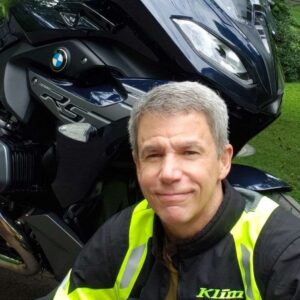
I just returned from my first day of genuine off-road riding in over two years. I’ve done a few easy dual-sport rides during that time, but this was legit single-track – tight, twisty, technical trails winding tortuously through dense woods, up and down steep slopes. At least there were no rock gardens, root mazes, deep water crossings or giant shelves to contend with, evil features common in my area which routinely assaulted or stymied me in the past. Instead, this was a network of relatively smooth, well-groomed paths on a riding buddy’s sprawling private property, a few of which I’d helped cut long ago when he first acquired the land. The most treacherous thing on this unseasonably temperate mid-November day was the thick blanket of recently fallen leaves that obscured surface irregularities and minimized available traction, along with numerous pinch-points wherein the gaps between trees were just barely wide enough to allow a set of handlebars passage – or not, requiring a quick twist and shimmy to sneak through.
Over the course of my 52 years as a motorcyclist, I’ve oscillated between off- and on-road riding. Early, when I could only afford to own one motorcycle at a time, this meant trading dirt- and street-bikes in fairly quick succession, having found dual-sport machines too frustratingly compromised in both applications. Once I realized the exorbitant financial drain of frequent buying and selling, I slowed down and made sure to have at least one of each genre in my stable at all times (more expensive at the front end, but less costly over time). Nevertheless, I continued to cycle through periods of much more consistent immersion in one or the other domain. While there are definitely advantages to such “cross-training,” with some skills more readily developed on each type of bike and in each environment, it was also always illuminating to discover how much I had to relearn after transitioning back to whichever mode I’d been neglecting. Like going back and forth between tennis and racquetball, many of the principles are similar, but far from identical. Trying to play one using the techniques of the other can be disorientingly disastrous.
As just one example, think about the relative dominance of counterbalancing off- and on-road. In the former – at least in slow technical work (my bike’s computer showed an average speed this day of just eight miles per hour) – there’s virtually nothing but counterbalancing. We’re always leaning away from the bike’s angle to offset its weight (modern trials bikes facilitate this with scooped-out midsections where the seats would normally be on any other type of motorcycle). On the street, such use of body weight comes into play during U-turns and other occasional low-speed maneuvers, but we’re much more often moving toward the inside of corners, at least with our upper torso, maybe even shifting our hips off the seat in that same direction. Of course, proper repositioning of either sort involves contrasting limb reconfigurations, too, with arms and legs bent and bearing weight differently. Muscle memory is key, as trying to reason out where everything should be is distracting and time-consuming, not to mention awkward and clumsy. When switching from offsetting gravity on one side to offsetting centrifugal force on the other (yes, I know the latter is technically a perceptual contrivance, but this isn’t physics class), a rider must not only get the new arrangement right, they must also resist the tendency to repeat the previous one; it’s not a “blank slate” situation, considerable erasing is required first.
Ideally, an adept motorcyclist would be fluently proficient in both low- and higher-speed body English, able to transition fluidly between the two as circumstances dictate and keenly aware of when to make the switch. In actual practice, the boundary line between these two opposing strategies can be something of a moving target, depending upon multiple variables like momentum, traction and chassis geometry in addition to just ground speed. Surely, you’ve already guessed where all this is going: on a bike I’d barely touched over the last two years, on a course featuring many simultaneously multidimensional challenges, doing a type of riding for which my muscle memory had devolved into some version of dementia, I SUCKED! And that’s before we even get to the physical strength, flexibility and stamina needed for this kind of riding. I thought I’d done a reasonable job of maintaining the relevant fitness, but the most important exercise for riding off-road has always been… riding off-road! While physical training no doubt contributes something to the project, there are muscles and reflexes unique to this activity that just can’t be sustained elsewhere. Their shelf life in the mind far exceeds their expiration date in the body; recalling abilities isn’t the same as still having them. I noticed muscles burning within the first several minutes, partly due to anxiety-driven inefficient overexertion, but also resulting from plain old atrophy. The five-mile loop we traversed felt like a full day’s labor, even though I would have considered it a modest demand back when I was last riding dirt on a regular basis, and even less of a challenge when I was doing so with decades-younger physiology.
A major – albeit certainly not new! – lesson from this experience is there’s simply no substitute for ongoing practice if a motorcyclist is to develop and hold onto riding skills. I won’t harp on this point here, as I’ve spent lots of words doing so over the years, but its truth is relentlessly undeniable and especially vivid during episodes like the one I’m describing. Aside from being the slowest guy in the group, I fell more times than everyone else combined (many more, although fortunately all my spills occurred at less than a walking pace with no bike damage or bodily injury). Whatever ability I’d had to coordinate traction and balance on tilted hairpins was 100% gone. I felt like I’d been trampled by cattle midway through the first lap, and I was profoundly demoralized by midday, more so by day’s end. It wasn’t that anyone was critical or annoyed – quite the contrary. My cohort regularly stopped to let me catch up, and one rode sweep behind me to help me get upright after my frequent slow-motion tumbles. I felt no scorn whatsoever from my observers. If anything, I imagined them feeling a bit sorry for me, wondering whence my obvious decline; was I deteriorating mentally and physically in ways they hadn’t realized? That’s probably a projection on my part, as that was the question running through my own mind throughout the day, with more fear and sadness than condemnation.

Compounding my sense of loss was the glaring contrast between my gross incompetence and the utterly uncanny – and outrageously unfair! – abilities displayed by my “boy,” Dylan, now 30, who had as a nine-year-old been my most avid and endearing trailside student (eventually surpassing his teacher’s skill level in late adolescence). To my awestruck amazement, he hopped on a completely unfamiliar borrowed bike and immediately kept up with the group leaders without a single mishap, despite having not thrown a leg over a motorcycle during the prior seven years. I really should have expected this, given that the last time we rode together he’d done the exact same thing, except that was on a three-day off-road tour in the Colorado mountains over the most insanely difficult terrain either of us had ever encountered, with him on another borrowed bike following another riding hiatus of over four years. At least then he proved himself slightly less than superhuman by taking one small spill during the initial hour of our first day there. Otherwise, he stayed at the front of the pack, seemingly with little effort, as I struggled further back, huffing and puffing, fussing and fuming, and sometimes regretting this choice of a college graduation present. (There were many preciously enjoyable moments, too, but mainly I clung to a hope the ordeal would be better in hallowed memory than it was for me in real-time.) Apparently, for some extraordinarily talented and exceptionally athletic young riders, regular practice might somehow be optional, although Dylan would have doubtless ridden even better with its benefits. For the rest of us mere mortals, however, it’s not something we can do without.
All parental figures must endure the inevitable waning of childhood idealization as developing kids become increasingly aware of our limitations and flaws. Back when we appeared heroic by simply exhibiting garden-variety grown-up competencies which our little admirers couldn’t possibly yet possess, we got to see glorified versions of ourselves through their naïve eyes. No matter how well we recognized the illusory nature of this phenomenon, it still felt exhilarating. Its loss is sobering, if not outright deflating. On this latest outing together, Dylan never looked askance at my difficulties, but he did chip in more spontaneously and extensively on the chores of bike transport and seemed to take a subtly protective stance toward me, perhaps without even realizing it. On one hand, it was great to see him assume more responsibility without any prompting from me. But, on the other hand, I felt another incremental, involuntary descent from my original pedestal as I gratefully accepted his assistance and concern. I know I’m not actually old and decrepit yet, but being so is more imaginable now than ever before. Ugh. One day it won’t just be serious single-track presenting this daunting a challenge, but perhaps all manner of motorcycle riding… Okay, enough of that train of thought!
On one level, this adventure was a perfectly fine, (partially) fun day of getting reacquainted with off-roading while enjoying the friendly, supportive company of fellow enthusiasts. Sure, it revealed the completely unremarkable skill degradation I expected, though to a greater degree than I was ready for. This was disappointing. But, at a deeper level, it was also an existential confrontation with some very unwelcome realities. I had to face, yet again, that I was no longer the man I used to be – not in terms of my physical and mental capacities, not in Dylan’s eyes, and not in my own. At 65, I am somewhere on the downhill side of my life’s trajectory, with no way of foreseeing how much lower I’ll go or how quickly I’ll get there. Much of this is outside my control, but some of it is amenable to my deliberate influence. If I want to continue riding single-track in the future (and I do), I will need to keep up my off-road skills with more regular practice – much more. In the process, I’ll have to lower my expectations and focus on rebuilding the basics, rather than throwing myself into challenges that used to be readily manageable, but which aren’t now. I cannot approach tasks with perceptions calibrated in a bygone era and expect to cruise through as though nothing has changed.

The Ride Inside with Mark Barnes is brought to you by the MOA Foundation. You can join the BMW Motorcycle Owners of America quickly and easily to better take advantage of the Paul B. Grant and Clark Luster training reimbursement programs offered by the Foundation.
Even with lots of fresh seat time in the woods, I will never again be the rider I was during Dylan’s youth. My body and brain are different. So are my risk tolerance and motivation. I’m no longer interested in conquering vertical, rocky mountainsides (not that I was ever good at it). The energy and stress costs are more than I’m willing to pay these days, and I’m much more worried about dealing with a compound fracture in the middle of nowhere than I was when the awareness of my own vulnerability was just beginning to dawn on me. I have enough aches and pains now without suffering through recovery from broken bones, or worse. My street riding has already become more sedately conservative as a result of such “maturation,” and so, too, must my off-roading.
I don’t mean to sound morbid and gloomy. Motorcycling remains a mind-blowingly gratifying activity I can’t imagine giving up, and I’m confident it will be among the brightest spots in my life as I continue to age. But I do have to take seriously the mental and physical entropy involved. Practice will forever be a prerequisite for competence, and I will have to keep adjusting my expectations to match the changing constraints of reality. That said, a more mellow relationship with riding needn’t be less rewarding, just as the adult-adult relationship I now have with Dylan isn’t inferior to the child-adult connection we had when he was little – it’s different, yes, but still thoroughly joyous.
Much has been written about the aging demographic of motorcyclists, and we definitely need to bring more young riders into the fold. But the flip side of that coin is the incredibly enduring passion for this activity found among its graying adherents. Somehow, it preserves our vitality in ways that defy explanation. Even as it exposes the effects of aging, it serves as a fountain of youthful drive.